

Are Financial Advisors Worth It

Money management today entails more than just saving; it also demands careful planning, informed decisions, and a defined long-term strategy. With numerous investment options, changing tax laws, and long-term goals like retirement or wealth creation, many people wonder: Are financial advisors really worth it? This question becomes even more important when a single action has a substantial impact on your financial security and peace of mind. In this blog, we discuss the true benefits of financial advisors, how they prevent expensive errors, and the situations in which expert advice may have a significant impact. Whether you are just starting on your financial journey or looking to optimize existing investments, understanding the role of expert advice can help you make informed decisions—especially when looking for the best Financial Advisors in Kerala to guide you toward smarter, more secure financial decisions. Are Financial Advisors Worth It? Should I Hire a Financial Advisor Managing your finances may be daunting, especially when you have to balance savings, investments, taxes, and long-term goals like retirement or asset growth. With so many financial products and techniques available, it’s reasonable to wonder: are financial advisors worth it, and should you hire one? A financial advisor combines professional expertise, market knowledge, and strategic planning to assist you in making educated decisions. They don’t simply recommend investments; they also help you match your money with your life goals, manage risks, optimize taxes, and establish a clear financial plan. This advice can help a lot of people avoid expensive errors and save a lot of time and frustration. Whether you’re a first-time investor, a business owner, or planning for major milestones, knowing the true value of professional advice can help you determine if hiring an expert is the right move—especially when choosing the best Financial Advisors in Kerala to support your financial journey with clarity and confidence. Reasons to Hire a Financial Advisor Expert Financial Planning: A financial advisor helps you create a structured plan based on your income, goals, risk appetite, and future needs, ensuring your money works efficiently for you. Informed Investment Decisions: With deep market knowledge and experience, advisors help you choose suitable investment options while avoiding common and costly mistakes. Better Risk Management: They assess potential risks and diversify your portfolio to protect your wealth during market fluctuations. Tax Efficiency and Savings: Financial advisors guide you on tax-saving strategies and compliant planning, helping you retain more of your hard-earned money. Long-Term Goal Alignment: From buying a home to retirement planning, an advisor ensures your financial strategy stays aligned with your life goals over time. Saves Time and Reduces Stress: By handling research, monitoring, and adjustments, a financial advisor allows you to focus on your personal and professional life. When your financial future matters, expert support is invaluable. You need to hire the best financial advisor in Kerala India, to gain clarity, confidence, and a well-planned path toward lasting financial security. Reason 1. Lack of Financial Knowledge One of the most significant issues many people face is a lack of financial awareness. Understanding investments, tax rules, insurance, and long-term financial planning takes time, research, and experience. Without the right information, it’s simple to make snap judgments, choose inappropriate investments, or pass up important chances. A financial advisor fills this gap by breaking down difficult financial ideas and offering you well-informed, data-driven advice. You get clarity and confidence in your financial decisions instead of speculating or depending on insufficient information—especially when you collaborate with experts who are aware of regional laws and market trends. Reason 2. Lack of Time to Handle Finance Related Matters In today’s fast-paced world, managing finances frequently takes a backseat to work, family, and personal obligations. Tracking assets, getting up to current on market trends, budgeting taxes, and assessing financial objectives all demand continuous time and attention, which many people lack. A financial advisor can assist by taking on these time-consuming tasks, ensuring that your finances are managed properly and proactively. They keep your financial plan on track while you focus on what is most important, such as monitoring portfolios and making appropriate adjustments. Reason 3. Growing Tax Burden As income and investments increase, so does the complexity of taxes. Many people pay more taxes than required because they are uninformed of lawful deductions, exemptions, and effective tax-planning tactics. A rising tax burden can have a substantial impact on your savings and long-term wealth if not managed correctly. A financial advisor can help you structure your income and investments in a tax-efficient manner while remaining fully compliant with rules. With the correct assistance, you may avoid excessive tax outflows while increasing overall returns. Reason 4. Financial Burden Affecting Mental Health & Relationships Financial stress can have a major impact on both mental health and personal relationships. Constant worry about bills, debts, or future financial security can cause anxiety, sleeplessness, and conflict at home. Decision-making, productivity, and even the caliber of your relationships may be impacted over time by chronic stress. By offering precise tactics, workable plans, and expert advice to manage debt, maximize expenditure, and make future plans, a financial advisor may lessen this load. With professional assistance, you can feel better, feel less stressed, and concentrate on having fun instead of worrying about money all the time. Reasons to Not Hire a Financial Advisor High Costs and Fees: Financial advisors charge fees, which can be a percentage of assets under management or a flat rate. For those with smaller portfolios, these costs might outweigh the benefits. You Have Strong Financial Knowledge: If you are well-versed in investments, tax planning, and budgeting, you may feel confident managing your finances without external help. Simple Financial Situation: Individuals with straightforward finances—like a single source of income, minimal debt, and basic savings—might not require professional guidance. Preference for Full Control: Some people prefer to make all financial decisions themselves and may find working with an advisor restrictive or unnecessary. Potential Conflicts of Interest: Not all advisors are completely unbiased; some may recommend products that benefit them
Partnership Firm – Everything You Need to Know

Starting a business with trusted partners can be exciting and profitable, and a Partnership Firm is still one of the most popular business forms in India. Simple to form, flexible to operate, and ideal for small to medium-sized ventures, partnership firms provide an efficient way for entrepreneurs to combine expertise, assets, and responsibilities. In this blog, Partnership Firm – Everything You Need to Know, we go over the fundamentals, from definition and features to benefits, legal requirements, and taxation. To assist you in making informed choices at every stage, Team Taxperts, valued for their extensive industry knowledge and hands-on expertise, share their expert opinion and practical guidance. With an established track record and client-focused approach, we stand out as a trusted Financial Advisor in Kerala, assisting businesses in building a solid financial foundation and staying compliant with ease. What is Partnership Firm A partnership firm is a type of business organization in which two or more people collaborate to run a business and share profits, losses, and duties in accordance with a mutually agreed-upon partnership deed. It is governed by the Indian Partnership Act, 1932. In a partnership firm, each partner provides funds, talents, or knowledge while actively participating in business management. A partnership deed often outlines the rules of operation, profit-sharing ratio, rights, and obligations, which helps prevent future misunderstandings. Due to their ease of formation, flexibility in management, and lower compliance requirements than other business forms, partnership firms are a popular choice for small and medium-sized enterprises. Is Registration of Partnership Firm Compulsory No. Registration of a partnership firm is not mandatory under the Indian Partnership Act, 1932. A partnership firm can lawfully operate even if it is not registered. However, establishing a partnership firm is strongly suggested because an unregistered firm suffers various legal constraints, such as: The firm cannot file a case against any third party to enforce contractual rights. Partners cannot sue each other or the firm to claim rights arising from the partnership agreement. The firm cannot claim set-off in legal proceedings. Conversely, a registered partnership firm benefits from enhanced legal protection, more credibility, and more seamless commercial operations. Opening bank accounts, applying for loans, and fostering confidence with customers and suppliers are all made easier with registration. How to Register a Partnership Firm In India, registering a partnership firm is an easy procedure. It starts with creating a Partnership Deed that clearly states the roles, responsibilities, capital contribution, and profit-sharing ratio of all partners. The firm must next file an application with the Registrar of Firms in the relevant state, together with the necessary documentation. The company is formally registered and issued a Certificate of Registration after verification. Team Taxperts offers end-to-end assistance to ensure a seamless and trouble-free process, from preparing the partnership deed to managing paperwork and registration requirements. As a reliable Financial Advisor in Kochi Kerala, we lead businesses through every step with our expertise and practical experience. Who is Beneficial Owner in Partnership Firm In a Partnership Firm, a Beneficial Owner is the person who ultimately owns, manages, or benefits from the firm, even if the business or assets are held in another name. Typically, the partners are the beneficial proprietors, because they: Have ownership rights in the firm Share profits and losses Participate in decision-making and control the business In cases where a partner represents another person or entity, the actual person who enjoys the economic benefits or exercises control is considered the beneficial owner. Finding beneficial owners is crucial for regulatory compliance, particularly for opening bank accounts, KYC standards, and anti-money laundering (AML) regulations. Who Can Be a Partner in Partnership Firm In a Partnership Firm, a partner is any person who is legally capable of entering into a contract under the Indian Contract Act, 1872. The following can be partners in a partnership firm: Individuals who are of sound mind and have attained the age of majority (18 years or above) Companies or LLPs, through their authorized representatives, if permitted by law Registered firms, subject to legal acceptance and the terms of the partnership deed Who cannot be a partner: Minors cannot be full partners, but they may be admitted to the benefits of partnership with the consent of all partners Persons of unsound mind Individuals disqualified by law It is easier to maintain legal compliance and efficient commercial operations inside the partnership firm when eligibility is clearly specified. How to Calculate Remuneration in Partnership Firm Remuneration in a Partnership Firm refers to the salary, bonus, commission, or other payments made to working partners for their active involvement in the business. The calculation of partner remuneration must be compliant with the Income Tax Act, 1961 and the terms mentioned in the partnership deed. How Remuneration Is Calculated As per the Partnership Deed: Remuneration is allowed only if it is clearly authorized in the partnership deed. If not mentioned, no remuneration is permitted for tax deduction purposes. Based on Book Profit: The maximum allowable remuneration is calculated on the firm’s book profit as per Section 40(b) of the Income Tax Act. Prescribed Limits: On the first ₹3,00,000 of book profit (or in case of loss): Higher of ₹1,50,000 or 90% of book profit On the balance book profit: 60% of the remaining book profit Within the Allowed Limit: The firm can pay any amount up to the above limits, and such remuneration will be allowed as a deductible expense. Key Points to Remember Remuneration is allowed only to working partners It must be reasonable and documented Excess remuneration over the prescribed limit is disallowed for tax purposes Proper calculation guarantees tax efficiency and compliance for the partnership firm. What is Meant by Reconstitution of Partnership Firm Reconstitution of a Partnership Firm describes any modification to the terms, structure, or makeup of the current partnership. It occurs when a partner’s rights, responsibilities, or stake are altered without the company being entirely dissolved. Common Scenarios Leading to Reconstitution: Admission of a New Partner: When a new person joins
How Freelancers Can Collect Their Money While Working Remote

Remote work has created global prospects for freelancers, allowing them to collaborate with clients from many countries and industries. Even though it’s now simpler to make money from home, many freelancers still struggle to get paid on time, legally, and securely. From international payment gateways to tax compliance and correct documentation, managing revenue as a freelancer necessitates extensive knowledge and experienced advice. This is where Team Taxperts comes in. With years of experience, Taxperts confidently guides independent contractors through payment collection, tax preparation, and regulatory compliance. As the best tax consultant in Kerala, Taxperts guarantees that your hard-earned money gets to you without needless delays, fines, or legal issues. How Freelancers Can Collect Their Money While Working Remote Remote freelancers frequently work with clients who are located in different places; prompt and safe payment collection is crucial. Using the appropriate payment methods—such as international bank transfers, digital wallets, or online payment platforms—can assist guarantee that transactions run smoothly. Proper invoicing, precise payment conditions, and knowledge of tax and compliance laws are all necessary to avoid delays or disagreements. Freelancers can effectively collect their money while concentrating on their remote work without stress by being aware of dependable payment methods and practicing sound money management. Popular Digital Platforms With the rise of remote work and global freelancing, digital payment services have become indispensable for receiving funds swiftly, securely, and easily. These systems make it simple for enterprises and independent contractors to handle both domestic and foreign payments. PayPal is one of the most widely used platforms worldwide, allowing users to receive international payments, send invoices, and withdraw funds to local bank accounts securely. Venmo is popular for quick peer-to-peer transactions, especially within the United States. It is commonly used for smaller payments and instant transfers between individuals. Zelle enables fast bank-to-bank transfers within the U.S., making it ideal for receiving payments directly into a bank account without waiting periods. Stripe is a powerful payment processing platform designed for businesses and freelancers who work with global clients. It supports multiple currencies, card payments, and seamless online integrations. Wise (formerly TransferWise) is known for its low-cost international transfers and transparent exchange rates, making it a preferred choice for freelancers receiving payments from abroad. When combined, these well-known online platforms streamline payment processing, shorten transaction times, and assist independent contractors in effectively managing their distant earnings. Traditional & Direct Methods Alongside digital platforms, traditional and direct payment methods continue to play an effective role in receiving payments, particularly for freelancers and professionals working with long-term or corporate clients. These techniques are prized for their direct link to bank accounts, traceability, and security. Bank Transfers: One of the most popular payment options is a bank transfer, which enables customers to send money straight to the freelancer’s bank account. They are appropriate for both domestic and international payments and provide detailed transaction records that are useful for accounting and tax purposes. Electronic Funds Transfer (EFT): It allows the digital movement of money from one bank account to another without the use of real money or cheques. EFTs are commonly used for salary payments, service fees, and routine transactions since they provide a secure and efficient way to receive funds. Traditional and direct methods like Bank Transfers and Electronic Funds Transfer guarantee reliable payment collection, making them perfect for freelancers who choose safe, bank-backed solutions with the correct financial documentation. How to Choose For International Clients Selecting payment solutions that facilitate cross-border transactions, numerous currencies, and competitive exchange rates is crucial when working with foreign clientele. Platforms such as PayPal, Stripe, and Wise are popular because they provide worldwide reach, secure payment processing, and speedier settlement. Freelancers should also consider transaction fees, currency conversion costs, and compliance with international tax regulations to guarantee effortless and affordable payment collection. For Domestic Clients Faster and easier payment methods are typically more efficient for domestic clientele. Bank transfers, Electronic Funds Transfer (EFT), and local digital payment systems all offer direct and secure transactions with low fees. These techniques are perfect for frequent payments within the same nation since they provide transparent payment records, speedier settlements, and convenience of use. Things to Note While Accepting Payment Freelancers must exercise caution while taking payments to ensure seamless transactions and avoid surprises. Here are some important things to think about: Contracts: Always have a clear, written agreement outlining the scope of work, payment terms, deadlines, and responsibilities. Contracts protect both parties and reduce disputes. Transaction Fees & Exchange Rates: Be aware of the fees charged by payment platforms and banks, especially for international payments. Exchange rates can also impact the amount you receive, so factor these costs into your pricing. Upfront Payments: Requesting partial or full upfront payments can protect you from non-payment or delayed payment. Decide the percentage based on project size and client trust. Invoicing: Generate professional invoices with clear payment instructions, due dates, and your banking/payment details. Proper invoicing ensures accountability and faster payment. Processing Time: Different platforms and banks have varying processing times. Keep this in mind when planning cash flow, especially for international clients. Compliance: Ensure all payments comply with local and international tax laws, financial regulations, and reporting requirements. This prevents legal issues and fines. Check for Hidden Fees: Before choosing a payment gateway, verify that there are no hidden charges for receiving money, withdrawals, or currency conversion. Hidden fees can significantly reduce your earnings. Keeping these criteria in mind allows freelancers to accept payments with confidence, reduce financial risks, and focus on their job rather than payment issues. Should I Seek Assistance From Team Taxperts Absolutely! Team Taxperts, recognized as the best tax consultant in Kochi, Kerala, brings years of experience in guiding freelancers and businesses through financial management, tax strategy, and regulatory compliance. You can guarantee prompt payment collection, accurate tax filing, correct invoicing, and compliance with all legal obligations with their professional assistance. Seeking help from Taxperts not only streamlines your financial operations but also provides you with peace of mind, allowing you
Everything you need to know about GST

Understanding GST can be difficult, especially given its frequent revisions, numerous compliance standards, and impact on businesses of all sizes. Whether you’re a startup owner, an experienced entrepreneur, or an individual attempting to understand taxation, having the appropriate knowledge is critical. In this blog, Team Taxperts, the best financial advisor in Kerala, explains all you need to know about Goods and Services Tax (GST), from the fundamentals and registration to filing, benefits, and common mistakes to avoid. With clear insights and practical advice, this guide will help you stay compliant and make better financial decisions. What is GST GST (Goods and Services Tax) is a unified indirect tax levied on the supply of goods and services in India. It replaced various indirect taxes such as VAT, service tax, excise duty, and others, bringing them under one common tax system. GST is intended to make taxation simpler, more transparent, and more efficient by removing the cascading impact of taxes. GST imposes tax at every stage of the supply chain, although firms can claim Input Tax Credit (ITC) for tax already paid on purchases. When Was GST Implemented in India GST was implemented in India on 1st July 2017. On this date, the Goods and Services Tax came into force, replacing several indirect taxes like as VAT, service tax, excise duty, and others, and establishing a unified tax system across the country under the notion of “One Nation, One Tax.” How Many Types of GST In India, there are four main types of GST: CGST (Central Goods and Services Tax): Collected by the Central Government on intra-state supplies of goods and services. SGST (State Goods and Services Tax): Collected by the State Government on intra-state supplies of goods and services. IGST (Integrated Goods and Services Tax): Collected by the Central Government on inter-state supplies and imports. UTGST (Union Territory Goods and Services Tax): Collected on intra-UT supplies in Union Territories without a legislature. When combined, these types guarantee efficient tax collection and revenue distribution among the Union Territories, States, and the Center. How GST Works GST operates on a value-added tax system, meaning that although taxes are levied at every point of the supply chain, the final consumer bears the majority of the tax burden. Here’s how it works simply: Tax at Every Stage: GST is levied whenever value is added—right from the manufacturer to the wholesaler, retailer, and finally the consumer. Input Tax Credit (ITC): Businesses can claim credit for the GST they have already paid on purchases. This means they pay tax only on the value they add, not on the entire transaction amount. Single Tax Structure: Instead of multiple indirect taxes, GST combines them into one system, reducing complexity and duplication. Intra-state and Inter-state Supply For sales within the same state, CGST and SGST are charged. For sales between different states, IGST is charged. Final Consumer Bears the Tax: While businesses collect and deposit GST with the government, the final cost of GST is borne by the end consumer. All things considered, GST guarantees transparency, prevents the cascading effect of taxes, and streamlines the tax system throughout India. What is GST Number A GST Number, also referred to as GSTIN (Goods and Services Tax Identification Number), is a distinctive 15-digit identification number provided to each organization or individual registered under GST in India. Structure of a GST Number First 2 digits: State code (as per Indian Census) Next 10 digits: PAN of the taxpayer 13th digit: Entity number (based on registrations under the same PAN) 14th digit: Default alphabet “Z” 15th digit: Check code (for error detection) Why a GST Number Is Important It allows businesses to collect and remit GST legally Mandatory for filing GST returns Required to claim Input Tax Credit (ITC) Helps in tracking transactions and ensuring compliance How to Apply for GST Number Obtaining a GST Number (GSTIN) in India is a simple online process. Here is an in-depth guide to help you comprehend how it operates: Check Eligibility: Before applying, ensure your business meets GST registration requirements based on turnover, type of business, or mandatory registration criteria. Visit the GST Portal: Go to the official GST portal and select the option for New Registration. Fill Part A of the Application Enter basic details such as: Legal name of the business PAN Email ID and mobile number An OTP will be sent for verification. Fill Part B of the Application After OTP verification, you will receive a Temporary Reference Number (TRN). Use this to complete the form by providing: Business address Nature of business activities Bank account details Details of promoters/partners/directors Upload required documents (PAN, address proof, photographs, bank proof) Submit Application with Digital Verification: Verify the application using DSC (Digital Signature Certificate), EVC, or Aadhaar authentication, and submit it. GSTIN Allotment: Once the application is verified and approved by the GST department, your GST Number (GSTIN) will be issued, usually within a few working days. GST registration is simple, but mistakes or missing information might cause delays or rejections. Consulting a skilled tax consultant in Kerala can assist in ensuring accurate filing, proper documentation, and seamless approval—especially for new and developing enterprises. How to Calculate GST Calculating GST is simple once you know the GST rate and whether the amount is exclusive or inclusive of GST. GST Calculation on an Amount (Exclusive of GST) Formula: GST Amount = (Original Price × GST Rate) ÷ 100 Total Price = Original Price + GST Amount Example: Original Price = ₹1,000 GST Rate = 18% GST = (1,000 × 18) ÷ 100 = ₹180 Total Price = ₹1,180 GST Calculation on an Amount (Inclusive of GST) Formula: GST Amount = [Original Price × GST Rate] ÷ (100 + GST Rate) Original Price = Total Price − GST Amount Example: Total Price (inclusive of GST) = ₹1,180 GST Rate = 18% GST = (1,180 × 18) ÷ 118 = ₹180 Original Price = ₹1,000 Common GST Rates in India 5%: Essential goods and services 12%: Standard goods
What is Input Tax Credit (ITC)
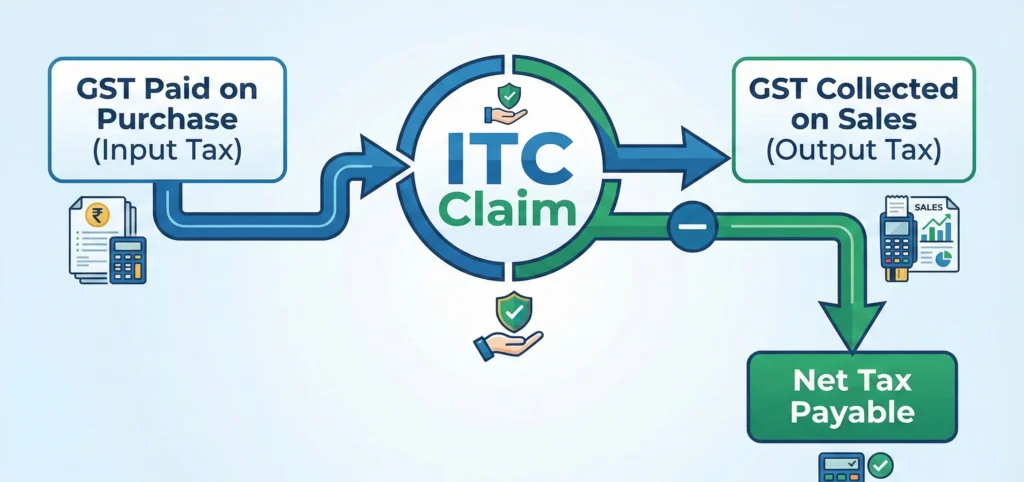
Input Tax Credit (ITC) is a GST system that allows firms to deduct the tax they have already paid on purchases from their overall output tax burden. In simpler terms, if your business buys goods or services and pays GST on them, you can claim that tax paid as a credit and offset it against the GST you need to pay on sales. This ensures that tax is only levied on the value contributed at each stage of the supply chain, preventing tax cascading. For accurate guidance on claiming ITC and maximizing tax benefits, Team Taxperts, a group of experienced tax professionals, can help. They are your go-to financial advisor in Kerala, providing knowledgeable guidance on ITC claims, GST, and general business financial planning. How Does ITC Work Input Tax Credit (ITC) enables businesses to lower the tax they pay on sales by using the GST they’ve already paid on purchases. The procedure is as follows, step-by-step: Purchase of Goods/Services: When a business buys goods or services, it pays GST to the supplier. Recording GST Paid: The GST paid on these purchases is recorded as input tax. Claiming ITC: When filing GST returns, the business can claim the GST paid on inputs as a credit. Offsetting Against Output Tax: The claimed ITC can be used to reduce the GST liability on sales (output tax). For example, if a business owes ₹10,000 in GST on sales but has ₹4,000 as ITC, it only needs to pay ₹6,000. Payment of Balance Tax: The remaining GST after applying ITC is paid to the government. Key Points: ITC can be claimed only if the goods/services are used for business purposes. Proper invoices and GST-compliant documentation are necessary to claim ITC. Why is Input Tax Credit Important Reduces Tax Burden: ITC allows businesses to offset the GST paid on purchases against the GST collected on sales, reducing the overall tax liability. Prevents Tax Cascading: Without ITC, tax would be charged on tax at every stage of production or supply. ITC ensures tax is levied only on the value added, preventing the “tax on tax” effect. Improves Cash Flow: By claiming ITC, businesses can lower the amount of GST they need to pay, helping maintain better cash flow for operations. Encourages Compliance: Businesses are motivated to maintain proper invoices and documentation to claim ITC, promoting transparency and accountability. Supports Business Growth: ITC helps reduce costs, making products and services more competitively priced, which can positively impact profitability and growth. Who All Are Eligible for Input Tax Credit Under GST, the following categories of taxpayers can claim ITC: Registered Businesses: Only GST-registered businesses can claim ITC. Unregistered entities are not eligible. Purchasers of Goods/Services for Business: ITC can be claimed on goods or services used for business purposes, such as raw materials, office supplies, or business-related services. Recipients of Taxable Supplies: Businesses receiving taxable goods or services (including imports) can claim ITC, provided GST has been paid by the supplier. Proper Documentation: Businesses must have a valid tax invoice, debit note, or other prescribed documents to claim ITC. Timely Filing: ITC can be claimed only if the GST returns are filed within the specified time under the GST laws. ITC is not available for personal use, motor vehicles (with a few exceptions), goods/services used for exempt supplies, or items like food and entertainment for personal consumption. How to Claim ITC Claiming ITC under GST involves a few key steps: = Ensure GST Registration: Only businesses registered under GST can claim ITC. Maintain Proper Documentation: Keep valid tax invoices, debit notes, or bills of supply for all purchases on which GST is paid. Check Eligibility: Ensure that the goods or services purchased are used for business purposes and are not excluded under GST rules. Match Supplier’s Details: Verify that the GST paid on purchases matches the details uploaded by the supplier in their GST returns. File GST Returns: Claim ITC while filing your monthly/quarterly GST returns (GSTR-3B). Enter the eligible credit in the designated ITC sections. Adjust Against Output Tax: Use the claimed ITC to offset your GST liability on sales. Pay only the balance tax, if any. Maintain Records: Keep all documents and records for at least 6 years, as they may be required during audits or assessments. How ITC Works in GST Input Tax Credit (ITC) under GST allows businesses to reduce their tax liability on sales by claiming credit for the GST already paid on purchases. Here’s how it works: Purchase of Goods/Services: A business buys goods or services and pays GST to the supplier. Recording GST Paid: The GST paid on these purchases is recorded as input tax. Claiming ITC: While filing GST returns, the business claims ITC on eligible purchases. Offsetting Against Output Tax: The ITC is used to reduce the GST payable on sales. Payment of Balance Tax: The remaining tax, after applying ITC, is paid to the government. Managing ITC and GST compliance can be difficult, especially with the regular changes in laws. Team Taxperts offers professional assistance for precise ITC computations and claims. Additionally, they provide accounting and bookkeeping services in India, assisting businesses in maintaining accurate, compliant, and structured financial records while maximising tax benefits. Benefits of Input Tax Credit Reduces Total Tax Liability: ITC allows businesses to use the GST paid on purchases to reduce the GST payable on sales, lowering their overall tax burden. Prevents Double Taxation: By eliminating the cascading effect (tax on tax), ITC ensures that tax is charged only on the value added at each stage. Improves Cash Flow: Since businesses pay only the net GST amount after applying ITC, it helps maintain better liquidity and smoother operations. Encourages Transparency: To claim ITC, businesses must maintain proper documentation and ensure supplier compliance, which promotes clean records and financial discipline. Enhances Profit Margins: Lower tax costs help reduce product or service pricing, improving profitability and market competitiveness. Supports Business Growth: With reduced financial strain and better cash management, businesses can reinvest in operations, expansion,