

India’s tax system is critical for funding public services, infrastructure, and government activities. It is designed to collect revenue from individuals, businesses, and other economic activities in an equitable and methodical manner. The Indian tax system is divided into two categories: direct taxes and indirect taxes, each with its own purpose, scope, and mode of collection.
Direct taxes are charged directly on a person or organization, such as income tax or corporate tax, while indirect taxes are imposed on goods and services, such as GST or customs duties. Anyone interested in the operation of the national economy, including firms and taxpayers, must comprehend these differences.
In this blog, we will look at the important characteristics of direct and indirect taxes in India, including their forms, calculation methods, and impact on individuals and businesses, to provide you with a clear picture of the country’s tax structure.
What is Direct Taxes
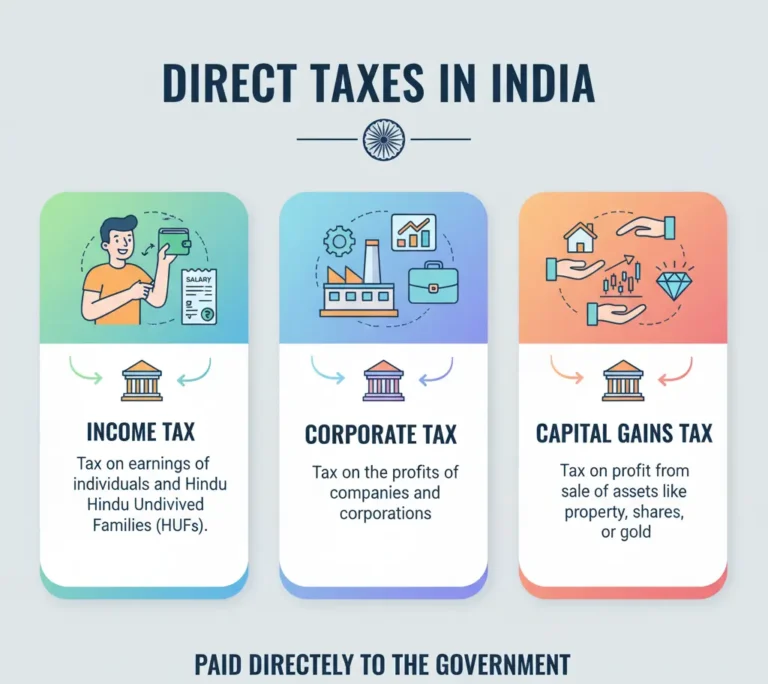
Direct taxes are those imposed directly on an individual’s or an organization’s income, wealth, or property. They are not transferred to another party; instead, the person or entity imposing them pays them directly to the government.
Key Features of Direct Taxes
- Paid Directly to the Government: You can’t pass it on; the person earning or owning the asset pays it.
- Based on Ability to Pay: Usually depends on income, profit, or wealth.
- Progressive in Nature (often): Higher income or wealth can attract higher tax rates.
- Cannot Be Shifted: The tax responsibility lies solely with the taxpayer.
Who Should Pay Direct Taxes
People who earn, own, or possess taxable income, profits, or assets are required to pay direct taxes. It basically operates on the “ability to pay” principle, which states that the more you possess or earn, the more you contribute.
Individuals
- Who: Salaried employees, professionals, freelancers, or anyone earning income.
- What they pay:
- Income Tax: On salary, business income, rental income, interest, dividends, etc.
- Capital Gains Tax: On profits from selling property, shares, or other investments.
- Example: A person earning ₹10 lakh per year must pay income tax according to the applicable tax slab.
Businesses / Companies
- Who: Private limited companies, corporations, LLPs, partnerships.
- What they pay:
- Corporate Tax: On profits earned by the company.
- Dividend Distribution Tax (in some countries): On dividends paid to shareholders.
- Example: A company making ₹50 lakh profit in a year pays corporate tax on that profit.
Owners of Property or Wealth
- Who: Individuals or organizations owning valuable property, land, or other assets.
- What they pay:
- Property Tax / Wealth Tax: Levied on real estate, land, or accumulated wealth (in countries where wealth tax exists).
Investors
- Who: People or entities investing in stocks, mutual funds, or other assets.
- What they pay:
- Capital Gains Tax: On profits from selling investments.
- Dividend Tax: On dividends earned from shares (in some jurisdictions).
Types of Direct Taxes
Income Tax
An income tax is a government-imposed payment on the earnings of people and corporations. As a direct tax, the burden cannot be shifted to another individual. The amount payable is computed using the taxpayer’s income, with different rates and laws depending on the jurisdiction.
- What it covers: Salaries, business income, rental income, capital gains, dividends, and other income sources.
- Key point: Income tax is progressive, meaning higher income attracts higher tax rates.
Corporate Tax
Profits made by businesses registered under Indian law are subject to corporate tax.
- Who pays: Private limited companies, LLPs, public companies, and other corporate entities.
- Purpose: Ensures businesses contribute their fair share to the government revenue.
Capital Gains Tax
Profits from the sale of assets like stocks, mutual funds, and real estate are subject to capital gains tax.
Types:
- Short-term capital gains – On assets held for a short duration.
- Long-term capital gains – On assets held beyond the specified period.
- Significance: Encourages long-term investment and tracks wealth generation.
Securities Transaction Tax (STT)
STT is assessed when stocks are traded on reputable Indian stock exchanges.
- Applicability: Shares, derivatives, and equity mutual funds.
- Purpose: Simplifies taxation on securities trading and ensures transparency in the stock market.
Equalization Levy
The Equalization Levy, also referred to as the “Google Tax,” is levied on payments made to digital service providers that are not residents.
- Purpose: Ensures foreign digital companies contributing to the Indian market pay taxes.
- Applicability: Online ads, e-commerce platforms, and digital services.
Tax Deducted at Source (TDS)
TDS is a mechanism where the payer deducts a portion of tax before making certain payments to the recipient.
- Applicability: Salaries, interest payments, rent, professional fees, commission, etc.
- Advantage: Helps in gradual tax collection and reduces tax evasion.
Tax Collected at Source (TCS)
TCS requires sellers of certain goods and services to collect tax from the buyer at the point of sale.
- Applicability: Sale of scrap, minerals, tendu leaves, parking lots, and more.
- Purpose: Ensures tax collection at the point of transaction.
Understanding direct taxes and managing compliance can be difficult owing to shifting regulations and numerous tax types.
Suppose you’re looking for a financial advisor in Kerala. In that case, Team Taxperts can assist you with every step of the tax process — from filing income tax to calculating TDS/TCS, corporate taxes, and capital gains.
Abolished Direct Taxes
Several direct taxes have been eliminated or replaced in India over time, often to simplify the tax structure or shift the tax burden. Key examples include the Wealth Tax, Gift Tax, and Dividend Distribution Tax. Additionally, several nations have completely abandoned personal income taxes in favor of alternative revenue streams.
Wealth Tax
- What it was: Tax on the net wealth of an individual, HUF, or company exceeding a certain threshold.
- Abolished: 2015
- Reason: Considered cumbersome to administer and replaced with higher income tax slabs and capital gains taxation for wealthier individuals.
Fringe Benefit Tax (FBT)
- What it was: A tax levied on companies for providing fringe benefits (like free meals, gifts, cars) to employees.
- Abolished: 2009
- Reason: Overlapping with income tax and considered administratively inefficient.
Dividend Distribution Tax (DDT)
- What it was: A tax levied on companies when they distributed dividends to shareholders.
- Abolished: 2020
- Reason: Replaced by taxing dividends directly in the hands of shareholders, making the system simpler and removing the cascading effect of taxes.
Surcharge on Certain Incomes (some categories)
Certain temporary surcharges on particular categories of income have been removed or altered over the years to facilitate direct taxation.
Why These Taxes Were Abolished
- Reduce tax complexity and administrative burden
- Avoid cascading effects where one tax leads to another
- Encourage investment and growth
- Simplify compliance and reporting
Benefits of Direct Taxes in Indian Economy
Revenue Generation for Government
- Direct taxes like income tax, corporate tax, and capital gains tax provide a steady and reliable source of revenue for the government.
- These funds are used to finance infrastructure, health, education, defense, and social welfare schemes.
Reducing Income Inequality
- Direct taxes are usually progressive, meaning people with higher incomes pay more.
- This helps redistribute wealth from richer sections of society to fund welfare programs for lower-income groups.
Promotes Financial Discipline
- Since direct taxes are based on actual income or wealth, taxpayers are encouraged to maintain proper records, accounts, and transparent transactions.
- This contributes to financial discipline among individuals and businesses.
Encourages Social Responsibility
- By paying taxes directly, citizens and corporations participate in the nation-building process.
Helps Control Inflation
- Through direct taxation, the government can reduce the disposable income of high earners, which in turn can control excessive spending and curb inflation.
- This acts as a stabilizing tool for the economy.
Facilitates Economic Planning
- Direct taxes provide predictable and stable revenue, which allows the government to plan long-term development programs and social initiatives.
Reduces Dependence on Indirect Taxes
- Since direct taxes are paid by the actual income earners, they reduce the need for excessive indirect taxes like GST or sales tax, which affect consumers broadly, including low-income groups.
- This helps make the tax system fairer.
What is Indirect Taxes
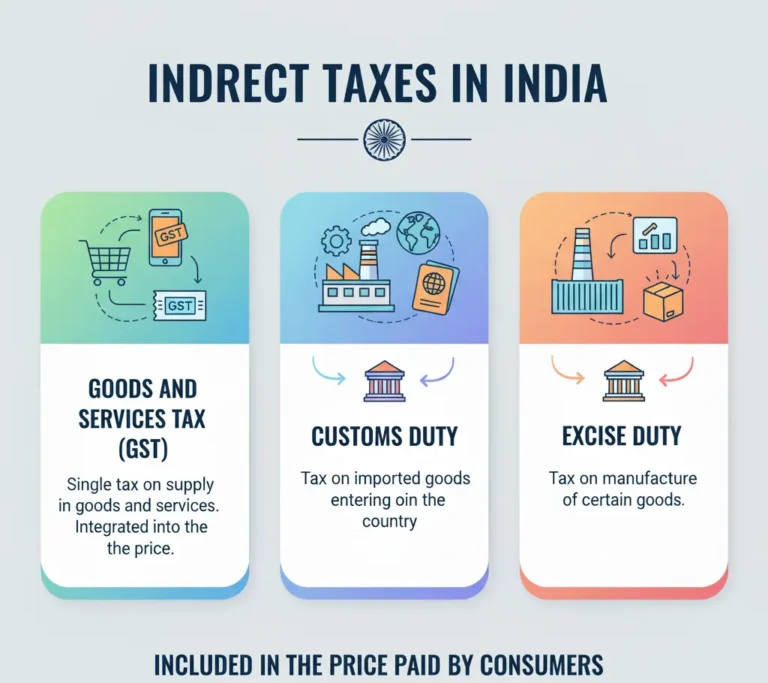
Indirect taxes are those imposed on goods and services rather than income or wealth, and the cost of these taxes can be passed on to the final consumer. Simply put, the seller gets the buyer’s tax and sends it to the government.
Key Features of Indirect Taxes
- Collected from Consumers via Sellers: The consumer pays the tax as part of the product or service price, and the seller remits it to the government.
- Shiftable Tax Burden: Unlike direct taxes, the tax burden can be shifted from the producer to the consumer.
- Applied to Goods and Services: It is generally imposed on sales, production, consumption, or import of goods and services.
- Regressive in Nature: Since it applies uniformly to everyone, low-income consumers may pay proportionally more of their income.
Common Examples of Indirect Taxes in India
- Goods and Services Tax (GST): A comprehensive tax on the supply of goods and services across India.
- Customs Duty: Tax on imported and exported goods.
- Excise Duty: Tax on the manufacture of goods within India (now largely subsumed under GST).
- Service Tax: Previously levied on services (now under GST).
- Value Added Tax (VAT): Levied on the sale of goods within states (mostly replaced by GST).
How Indirect Taxes are Collected?
Indirect taxes are collected indirectly, rather than directly from taxpayers, through the sale or distribution of goods and services, which means that the tax is integrated in the price and passed on from one entity to another until it reaches the government. Here is a detailed explanation of how this operates:
Collection at the Point of Sale
- The seller adds the tax to the price of goods or services.
- The buyer pays the total amount, which includes the tax.
Remittance to the Government
- The seller or service provider remits the collected tax to the government periodically (monthly, quarterly, or annually).
- This ensures that the end consumer bears the tax burden, but the government receives it via the business.
Flow of Tax Payment
- The manufacturer produces goods → charges tax to the wholesaler →
- Wholesaler charges tax to retailer →
- Retailer charges tax to consumer →
- Retailer deposits the tax collected with the government.
This chain guarantees that the government collects tax at many stages, known as the cascading effect, but contemporary systems, such as GST, offer input tax credits to avoid double taxation.
Key Methods of Collection
- GST (Goods and Services Tax): Collected at each stage of supply; businesses can claim input tax credit.
- Customs Duty: Collected when goods are imported or exported.
- Excise Duty (pre-GST era): Collected from manufacturers.
- Service Tax (pre-GST era): Collected from service providers.
Summary
- Indirect taxes are included in the price of goods and services.
- The final consumer pays the tax.
- Businesses act as intermediaries to collect and remit the tax to the government.
- Modern systems like GST ensure transparency and prevent double taxation through input tax credits.
Is Indian Economy Growing in the Last 11 Years
Yes, the Indian economy has developed substantially over the last 11 years, although the growth has undergone fluctuations caused by global and local factors. Let’s examine it precisely:
GDP Growth
- Over the past decade (2014–2025), India’s GDP has mostly remained among the fastest-growing major economies in the world.
- Average annual growth rate: Approximately 6–7%, though it has varied:
- 2015–2019: Robust growth around 7% per year.
- 2020: Sharp slowdown due to COVID-19 pandemic; GDP contracted by ~7.3%.
- 2021–2022: Rapid recovery with growth rates around 8–9%.
- 2023–2025: Moderate but stable growth expected, around 6–7%.
Key Drivers of Growth
- Services Sector: IT, software exports, and financial services have been major contributors.
- Manufacturing & Make in India: Government initiatives like Make in India and production-linked incentives (PLI) boosted manufacturing.
- Infrastructure Development: Roads, metro projects, ports, and smart cities contributed to economic expansion.
- Consumption: Rising middle class and domestic consumption have fueled demand.
- Foreign Investment: FDI inflows and global capital investments increased steadily.
Reforms Supporting Growth
- Goods and Services Tax (GST) (2017) simplified indirect taxation.
- Banking and financial reforms improved liquidity and investment.
- Digital initiatives: Digital payments, UPI, and fintech growth accelerated economic activity.
- Labour and business reforms: Simplified processes encouraged entrepreneurship.
Challenges Faced
- COVID-19 pandemic caused a temporary contraction in 2020.
- Inflationary pressures and global economic uncertainties impacted growth.
- Employment generation has been slower than GDP growth in certain years.
Overall Assessment
- Despite occasional slowdowns, India’s economy has grown significantly in the last 11 years.
- It has strengthened its position globally, becoming a key player among emerging markets.
- The trend shows long-term resilience and growth potential, driven by structural reforms, services, manufacturing, and consumption.